The Regions of Tuscany: A Complete Area-by-Area Guide
Tuscany is a single name for a remarkably varied region. The vine-covered hills around Florence look nothing like the cypress-lined clay plains of the Val d'Orcia; the walled streets of Lucca feel worlds away from the pine forests and beach coves of the Maremma coast. Understanding the regions of Tuscany and what makes each one distinct, is the foundation of choosing the right base for a villa holiday.
Tuscany at a glance: Tuscany (Toscana in Italian) is one of Italy's 20 administrative regions, located in central Italy on the western (Tyrrhenian) side of the peninsula, with Florence as its capital. For holiday planning, Tuscany is most commonly divided into four to six sub-regions, Chianti (between Florence and Siena), Val d'Orcia (south of Siena), the Tuscan Coast and Maremma (southwest), the Lucca countryside (northwest), and the Valdichiana around Cortona (east), each with a distinct landscape, food and villa rental profile.
What Part of Italy Is Tuscany In?
Tuscany sits in central Italy, on the western (Tyrrhenian) side of the peninsula. It is bordered by Liguria and Emilia-Romagna to the north, the Marche and Umbria to the east, and Lazio to the south. Its capital is Florence (Firenze). The landscape covers everything from the Apennine mountains in the east to a 200-kilometre Mediterranean coastline in the west, with the Arno river cutting east-to-west through the heart of the region.
How Many Regions Does Tuscany Have?
Two answers, depending on what you mean. Administratively, Tuscany is one of Italy's 20 regions, subdivided into ten provinces: Firenze, Siena, Arezzo, Grosseto, Lucca, Pisa, Livorno, Pistoia, Prato and Massa-Carrara. For holiday planning, Tuscany is most usefully thought of as four to six sub-regions, each with a distinct landscape and travel character: Chianti, Val d'Orcia, the Maremma and Tuscan Coast, the Lucca countryside (Lucchesia, Versilia, Garfagnana), and eastern Tuscany around Cortona and Arezzo. The rest of this guide covers each in detail.
Tuscany Region Map with Towns
The principal towns and cities of Tuscany cluster by region. Northwest (Lucca area): Lucca, Pisa, Viareggio, Forte dei Marmi, Barga. Central-north (Chianti): Florence, Greve in Chianti, Panzano, Radda in Chianti, Gaiole, Castelnuovo Berardenga. Central (Siena area): Siena, San Gimignano, Volterra, Monteriggioni. South-central (Val d'Orcia): Montepulciano, Pienza, Montalcino, San Quirico d'Orcia, Bagno Vignoni. Southwest (Maremma and Tuscan Coast): Grosseto, Castiglione della Pescaia, Pitigliano, Sorano, Saturnia, Capalbio. East (Valdichiana and Arezzo): Arezzo, Cortona, Sansepolcro, Anghiari. For a visual breakdown of how these towns and regions sit together, see our printable map of Tuscany.
Detailed Map of the Tuscany Region
A detailed map of the Tuscany region needs to show three layers: the ten administrative provinces (the formal boundaries), the four to six holiday sub-regions (the practical planning boundaries), and the key driving routes that connect them. Our free printable PDF map of Tuscany covers all three layers, including the SS222 Chiantigiana road through Chianti, the SS2 Via Cassia through the Val d'Orcia, the SS1 Aurelia coastal route, and the A1 motorway that runs north-to-south through the region's eastern edge.
The Regions of Tuscany: An Overview
Tuscany covers roughly 23,000 km² and is officially divided into ten provinces: Firenze, Siena, Arezzo, Grosseto, Lucca, Pisa, Livorno, Pistoia, Prato and Massa-Carrara. For holiday planning, these administrative lines matter less than the six or seven broader landscape zones that have developed their own distinct character, wine identity and travel culture over centuries. The map of Tuscany shows how these areas sit geographically relative to each other, worth ten minutes of study before choosing a villa base.
At the broadest level: the northern and central strip (Chianti, Crete Senesi, Val d'Orcia) is Tuscany's heartland, the landscape of rolling hills, estate wines and hilltop towns that defines most people's mental image of the region. The southwest (Maremma, Tuscan Coast) is wilder, less visited and uniquely combines inland countryside with genuine beach access. The northwest (Lucca, Versilia, Garfagnana) is greener, mountainous and historically undervisited by international villa guests. Eastern Tuscany (Arezzo, Cortona, Valdichiana) connects more naturally to Umbria than to Chianti wine country.
Chianti, The Classic Villa Region
The heartland of Tuscan villa holidays. Chianti runs roughly 60km south from Florence along the SS222 Chiantigiana road, through the wine-country villages of Greve in Chianti, Panzano, Radda in Chianti, Gaiole and Castelnuovo Berardenga, before reaching the outskirts of Siena. The landscape here is what most people mean when they say 'Tuscany': south-facing terraces of Sangiovese vines, stone farmhouse conversions with long gravel drives, olive groves, ancient stone walls, and cypress avenues marking the boundaries between estates.
The Chianti Classico DOCG, the historic core of the wine zone between Greve and Castellina, is the densest concentration of estate wine producers in Tuscany, and wine visits are straightforward without advance booking. The Thursday market in Greve, the Saturday market in Radda, and the Wednesday market in Panzano all give a strongly local feel that makes Chianti work as a base rather than merely a view. Food is central: this is where ribollita, bistecca alla Fiorentina, pecorino, crostini di fegatini and the robust local Tuscan cuisine are at their most authentic. Chianti villas have the highest density of any region, meaning the widest selection at every price point. Browse Chianti villas →
Best for: First-time visitors to Tuscany, wine lovers, couples, mixed groups wanting Florence and Siena day trips without long drives. The most practical all-round base in the region.
Nearest cities: Florence 45 min, Siena 30-40 min.
Val d'Orcia, Tuscany's UNESCO Landscape
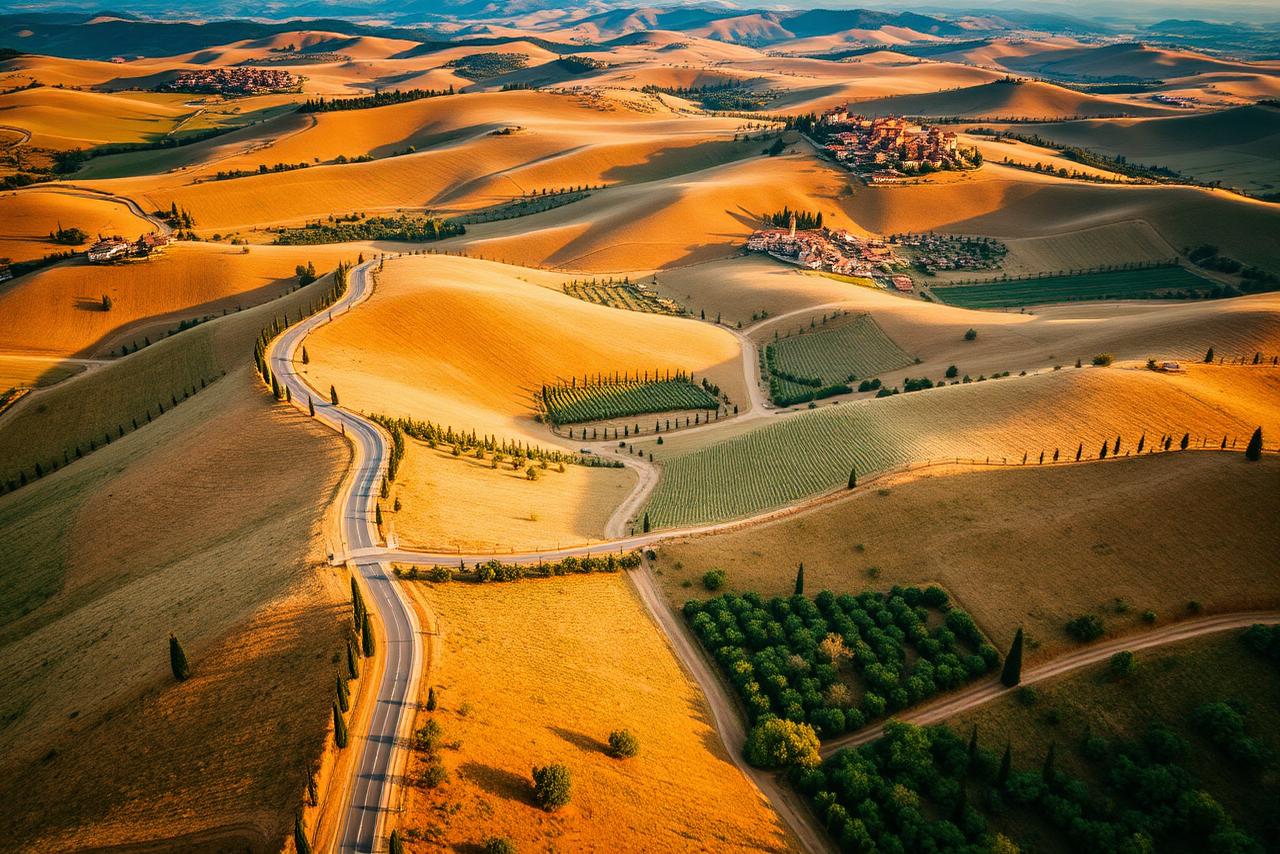
The Val d'Orcia is the region that defined the 'iconic Tuscany' image recognised worldwide, the rolling clay hills, the isolated cypress avenues, the pale road winding between Pienza and Montalcino at dawn. The valley received UNESCO World Heritage designation in 2004 in recognition of its extraordinary Renaissance agricultural landscape, which has survived largely unchanged since the 14th century. It occupies the southeast quadrant of the Tuscany map, roughly 90-120 minutes from Florence by car.
The anchor towns are exceptional. Pienza is the ideal Renaissance city, designed in 1459 on the orders of Pope Pius II and still largely intact, with extraordinary views from the Duomo terrace over the valley floor. Montalcino, on a ridge above the valley, produces Brunello di Montalcino, widely regarded as one of the world's great red wines. Montepulciano, to the east, is a dramatic hilltop town at 605m producing Vino Nobile, structured and criminally underrated internationally. Bagno Vignoni is unique: a thermal village built around a large Renaissance pool of bubbling spring water in the village square itself.
The tradeoff for its beauty is remoteness. Florence from a Val d'Orcia villa is around two hours each way, manageable once but a long commitment if repeated. Most guests use Siena (40-60 min) as their city excursion and treat the valley towns as the primary itinerary. Many Val d'Orcia villas sit at the end of long unpaved strade bianche, check access conditions before booking if narrow lanes are a concern. Browse Val d'Orcia villas →
Best for: Landscape photography, Brunello wine lovers, couples on a second or third Tuscany visit, guests who prioritise seclusion and spectacle over city access.
Nearest cities: Siena 40-60 min, Florence 2 hours.
Maremma and the Tuscan Coast, The Wild Southwest
The Maremma is the least visited and most underrated of Tuscany's main holiday regions, a large, sparsely populated area of pine forests, coastal wetlands, volcanic hilltop towns and long sandy beaches in the southwest corner of the region. Unlike the densely farmed Chianti hills, much of the Maremma interior is still covered with macchia (Mediterranean scrubland), and the regional park south of Grosseto protects a remarkable stretch of coast and hinterland.
The coastline is the main point of difference from other Tuscany regions. The stretch from Castiglione della Pescaia south to Monte Argentario offers some of the finest and least-crowded beaches in central Italy, Feniglia, Tombolo di Castiglione, Cala Violina, with clear water and good beach infrastructure. Offshore lie the Tuscan islands: Elba (ferry from Piombino) and the smaller Giglio and Capraia. The interior harbours extraordinary towns that few international visitors ever reach: Pitigliano rises sheer from a volcanic tufa outcrop above a gorge; Sorano and Sovana are similarly dramatic; the natural hot springs at Saturnia are free, open year-round, and one of the great free experiences in Italy. Browse Maremma and coastal villas →
Best for: Beach plus countryside combinations, families in June and September, guests who want genuinely off-the-beaten-track Tuscany. Also excellent for Etruscan history, horse riding and bird-watching.
Nearest cities: Grosseto 30 min, Siena 90 min.
Lucca and the Northwest, Walled City and Green Hills
Northwestern Tuscany is the most distinct of all the regional zones, greener, wetter, more mountainous, and anchored by Lucca, one of the most perfectly preserved walled cities in Italy. Unlike the landlocked hill towns of Chianti and the Val d'Orcia, Lucca sits on a flat plain at low altitude, surrounded by intact Renaissance walls (4km in circumference, wide enough to walk and cycle on the top). The city has an excellent restaurant and bar scene, good food markets, and far fewer visitors than Florence in any season.
Behind Lucca, the Serchio Valley climbs rapidly into the Apuan Alps and the Garfagnana, a completely different Tuscany: forested, cool in summer, snowy in winter, dotted with medieval stone villages and marble quarries. The Versilia Riviera stretches along the coast to the north, with the resort towns of Forte dei Marmi and Viareggio. The Cinque Terre is 90 minutes north on the motorway, a viable day excursion from a northwest Tuscany base. For a full guide to the city itself, see our Lucca travel guide.
Best for: Guests with Lucca as a primary destination; those who find July-August Chianti too hot (the higher Garfagnana runs 5-8°C cooler); guests arriving via Pisa airport who prefer a short transfer.
Nearest cities: Pisa 30 min, Florence 80 min.
Crete Senesi and Around Siena
The Crete Senesi (literally, 'the Siena clays') is a sub-region south of Siena characterised by bare clay hills, sparse farmhouses and a wide-open landscape quite different from vine-covered Chianti. The pale grey clay soil (biancane) weathers into rounded hills and eroded formations called balze. It is less visited than the Val d'Orcia despite being equally photogenic, particularly in spring when the hills are briefly green and wildflower-scattered, or in autumn when ploughing reveals the raw clay.
The main town is Asciano, with a small but worthwhile Etruscan museum. The Abbazia di Monte Oliveto Maggiore, a large Benedictine monastery set in a cypress grove above the clay valley, contains remarkable fresco cycles by Luca Signorelli and Il Sodoma, and is one of the finest monastic complexes in Italy. Much of the Crete Senesi is within easy reach of Siena (20-40 min) and combines naturally with a Val d'Orcia villa base as an additional day's exploration.
Eastern Tuscany: Arezzo, Cortona and the Valdichiana
Eastern Tuscany is where the region begins to merge with Umbria, its landscape of gentle hills and broad valleys shares more with the Umbrian countryside than with Chianti wine country. The main city is Arezzo, a historic Etruscan and Roman city with one of Italy's best antiques markets (first Sunday of each month, plus the Saturday preceding it) and an extraordinary cycle of frescoes by Piero della Francesca in the church of San Francesco.
Cortona, on a steep hill above the Valdichiana plain, is one of the oldest inhabited cities in the world, an Etruscan settlement with superb views over Lake Trasimeno in Umbria. It has a strong local restaurant scene and receives far fewer visitors than its fame (it featured in Frances Mayes's writing) would suggest. Montepulciano, accessible from the east, is the hilltop home of Vino Nobile di Montepulciano, a serious red wine that rewards the detour. The Valdichiana plain between Arezzo and Chiusi provides fast motorway access and a practical transit corridor through southern Tuscany.
San Gimignano, Volterra and Western Tuscany
Western-central Tuscany between Siena and the coast contains some of the region's most distinctive towns. San Gimignano is famous for its fourteen surviving medieval tower houses, the 'Manhattan of the Middle Ages'. Visitor numbers peak sharply in summer, so early mornings are exceptional and midday should be avoided in high season. The local Vernaccia white wine is worth drinking; the town rewards an overnight stay far more than a coach-tour stop.
Volterra is a dramatically situated Etruscan and medieval city on a high spur west of Siena, more severe and less polished than San Gimignano, and proportionally more rewarding for it. The Etruscan museum is outstanding; the alabaster workshops that line the streets still produce genuine hand-worked pieces; the cliff walks on the town's western edge offer some of the most dramatic views in Tuscany.
Umbria, Tuscany's Southern Neighbour
Umbria is a separate Italian region, not part of Tuscany, but it belongs on any guide to the regions of Tuscany because it integrates so naturally into a Tuscany villa holiday. Southern Tuscany bases (Val d'Orcia, Crete Senesi, the Valdichiana) put Umbria within easy reach, and the border is crossed seamlessly on unmarked back roads. The Umbria destination page on this site covers the area in full.
The key Umbrian towns for day trips from Tuscany: Orvieto (a spectacular tufa-cliff city with an extraordinary Gothic cathedral and excellent white wine), Assisi (birthplace of St Francis, with basilica frescoes by Giotto and Cimabue), Perugia (Umbria's lively university city with a good Etruscan arch and food culture), Spoleto (a beautiful, under-visited medieval city), and Gubbio (arguably the best-preserved medieval city in central Italy). Umbria's countryside shares Tuscany's hill-town character at a fraction of the visitor density and typically at lower prices. Browse Umbria villas →
Choosing the Right Tuscany Region for Your Holiday
The decision usually comes down to three questions: how important is beach access, how far are you willing to drive for city day trips, and how experienced are you in Tuscany? For first visits, Chianti nearly always wins on practical grounds, central location, best road access, widest villa selection, Florence and Siena both within easy reach. For guests returning for a second or third time, the Val d'Orcia or Maremma typically provide the new experience they are looking for.
If beach access is non-negotiable for any part of the group, the Maremma is the only answer, other Tuscany regions are more than an hour from the sea. If wine is the primary driver, Chianti (Chianti Classico) and the Val d'Orcia (Brunello di Montalcino) are both outstanding but in different styles. If remoteness and genuine privacy matter most, the deeper Val d'Orcia and the higher Garfagnana are the options that deliver real seclusion.
For a full region-by-region comparison with honest pros and cons, see our guide to the best areas to rent a villa in Tuscany. To start browsing by region, go to our destination pages, or contact the team with your dates and priorities.
Frequently Asked Questions About the Regions of Tuscany
What are the regions of Tuscany?
Tuscany is officially divided into ten provinces but the main holiday regions are Chianti (between Florence and Siena), Val d'Orcia (south of Siena, UNESCO-listed), Maremma and the Tuscan Coast (southwest, with beach access), Lucca and the northwest, the Crete Senesi and eastern Tuscany (Arezzo, Cortona). See our map of Tuscany for how they sit geographically.
Which region of Tuscany is best for a first visit?
Chianti is the most practical first-time base, centrally placed between Florence and Siena, with excellent villa selection, good road access and day-trip options in every direction. For guests who specifically want the UNESCO Val d'Orcia landscapes and don't mind fewer city day trips, booking directly into that region for a first visit works well too.
Which Tuscany region is best for beach holidays?
The Maremma and Tuscan Coast, specifically the stretch from Castiglione della Pescaia to Monte Argentario, is the only Tuscany region with proper beach access. Other regions are more than an hour from the sea. See our Tuscan Coast and Maremma destination page for villas in the area.
What is the difference between Chianti and Val d'Orcia?
Chianti is vine-covered, central and practical, close to both Florence and Siena, with good roads and the widest villa selection in Tuscany. Val d'Orcia is more remote, more dramatic in landscape (UNESCO-listed) and focused on a different wine identity (Brunello and Vino Nobile rather than Chianti Classico). Val d'Orcia guests typically prioritise landscape and seclusion over city access.
Is the Maremma worth visiting in Tuscany?
Absolutely, the Maremma is arguably Tuscany's most underrated region. Wild beaches, Etruscan hill towns (Pitigliano, Sorano), the natural hot springs at Saturnia, and a genuinely off-the-beaten-track character that is rare in the rest of the region. June and September are the ideal months, warm sea, no August crowds.
What is the Val d'Orcia famous for?
The Val d'Orcia is famous for its UNESCO-listed landscape, the rolling clay hills, cypress avenues and isolated stone farmhouses that feature in most 'iconic Tuscany' photography. It is also home to Brunello di Montalcino, Vino Nobile di Montepulciano, Pienza pecorino cheese, and three extraordinary hilltop towns: Pienza, Montalcino and Montepulciano.
Next step: choosing the type of property
Once you've chosen your region, the next decision is what kind of property suits you, a private villa for exclusive use, an agriturismo with breakfast included, a borgo for a large group, a castello for a milestone celebration. See our guide to Italian accommodation types for the practical differences between villa, agriturismo, fattoria, podere, casa colonica, borgo, castello and the other terms you'll see in Tuscan property listings.