Map of Tuscany with Towns, Regions & a Printable PDF
Tuscany stretches for 230km from north to south, covering ten provinces, four distinct holiday regions, and some of Europe's most celebrated landscapes. Whether you're planning which region to base yourself in, working out realistic driving distances, or simply trying to understand how the map fits together before you book, this guide covers every corner.
Where is Tuscany?
Tuscany is a region in north-central Italy, on the western (Tyrrhenian) coast of the country, roughly halfway between Rome and Milan. It lies about 300km north of Rome and 300km south of Milan, with Florence as its capital. On a map of Italy, Tuscany sits slightly above the country's geographic middle, north of Lazio (the region containing Rome), south of Emilia-Romagna, and east of the Tyrrhenian Sea.
Tuscany (Toscana in Italian) faces the Ligurian and Tyrrhenian seas on its western side. The region is the large, roughly triangular area immediately north of Lazio and south of Emilia-Romagna. It shares inland borders with Umbria to the east, the Marche to the northeast, and Liguria to the northwest. Its long western edge is coastline, stretching from the Ligurian Riviera down to the Maremma and the Argentario peninsula.
In practical travel terms, Tuscany lies roughly 300km north of Rome and 300km south of Milan. Florence, the regional capital, is served by direct high-speed trains, around 90 minutes from Rome Termini and just over 100 minutes from Milan Centrale, which makes a Tuscan villa week easy to pair with a night or two in either city. For international visitors, the region is most often accessed via Pisa Galileo Galilei airport on the west coast, which handles most low-cost flights from the UK and northern Europe, with Florence Peretola a smaller alternative for shorter-haul European connections.
Tuscany is one of Italy's twenty official regions and one of the largest by area, about 23,000 km², roughly the same size as Wales. Inside the region, ten provinces are drawn around the main cities: Firenze, Siena, Arezzo, Grosseto, Lucca, Pisa, Livorno, Pistoia, Prato and Massa-Carrara. For holiday planning, these administrative lines matter less than the four broader holiday zones, Chianti, Val d'Orcia, the Tuscan Coast and Maremma, and neighbouring Umbria, which are mapped out in detail in the sections below.
Tuscany Map with Cities
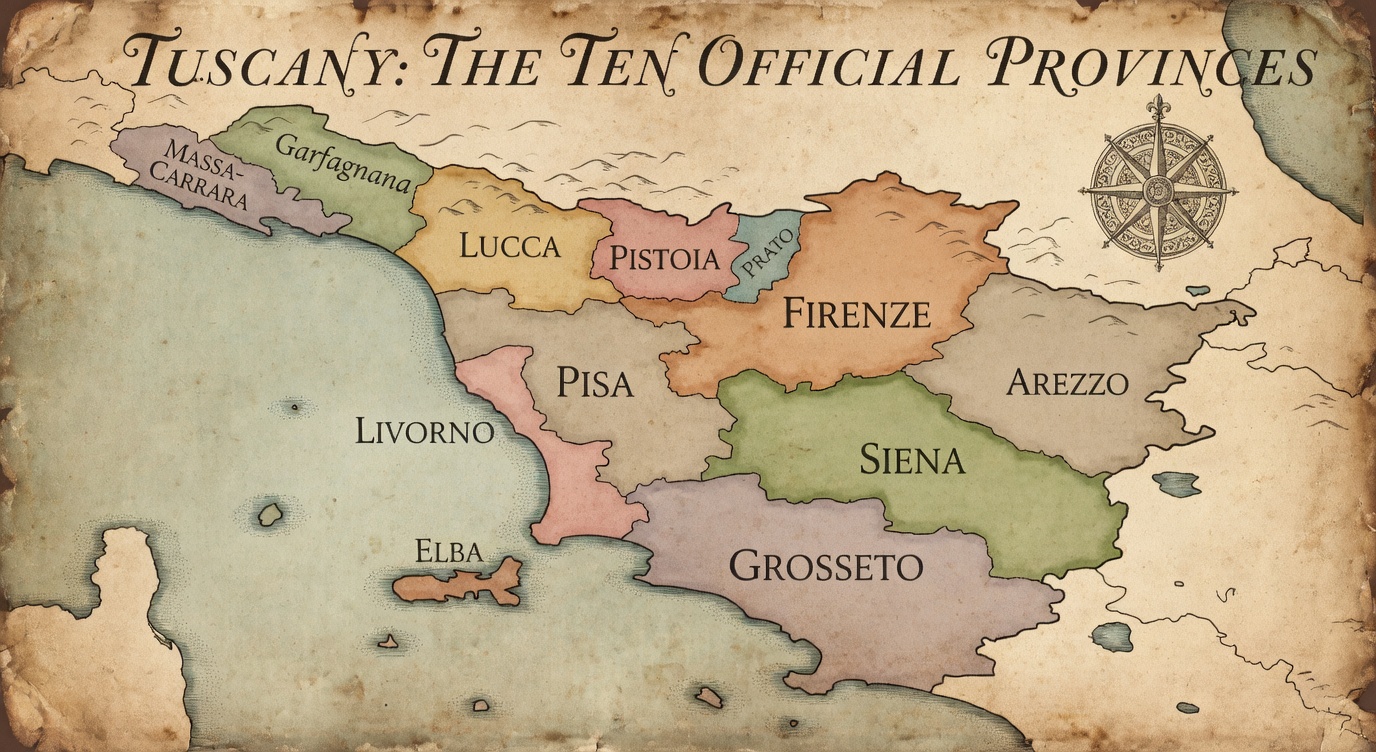
Tuscany's main cities are spread unevenly across the region. Florence anchors the north, Siena the centre, and Grosseto the southwest. Understanding where each city sits on the map is the first step to planning realistic day trips from a villa base.
Florence (Firenze), The regional capital and most visitors' first stop. Florence sits in the northern third of Tuscany, 80km from Pisa and 75km north of Siena. The city is served by two airports (Peretola/Florence and Pisa Galileo Galilei), a central train station on the high-speed rail network, and fast motorway links south to Chianti and Siena. From a villa in northern Chianti, Florence is a 45-minute drive.
Siena, The second city and the gateway to the central and southern Tuscany map. Siena is 75km south of Florence by motorway (around 90 minutes from Florence airport) and is the natural anchor for the Crete Senesi and the Val d'Orcia. Most Val d'Orcia villas sit 40-60 minutes southeast of Siena; the Piazza del Campo and Duomo are worth half a day at minimum.
Pisa, Best known internationally for the Leaning Tower, but Pisa also has a beautiful riverside setting, an intact medieval core, and an international airport that serves Tuscany's northwest. The city is 80km west of Florence and 30 minutes from Lucca. Arrival and departure via Pisa is often more convenient than Florence for guests staying in western Tuscany.
Lucca, The most underrated large city in Tuscany. Lucca's intact Renaissance walls enclose a compact historic centre with excellent food, a relaxed local atmosphere, and far fewer tourist crowds than Florence or Siena in high season. It is 80km west of Florence and 30 minutes north of Pisa. For villas in the northwest, Lucca is the natural city base for an afternoon or evening.
Arezzo, In the east of Tuscany, closer to Umbria than to the Tuscan heartland. Arezzo is less visited than the Chianti towns but rewards the effort: it has exceptional Piero della Francesca frescoes, a famous monthly antiques market, and a convenient location for the Valdichiana, Cortona, and Montepulciano.
Driving distances & times from Florence
| Destination | Distance | Drive Time | Notes |
|---|---|---|---|
| Siena | 75 km | 1 hr 15 min | Via A1 or SS2 scenic route |
| Greve in Chianti | 30 km | 45 min | Heart of the Chianti wine region |
| San Gimignano | 55 km | 1 hr | West of Siena, the tower town |
| Montepulciano | 115 km | 1 hr 45 min | Valdichiana, Vino Nobile wine |
| Pienza | 120 km | 1 hr 45 min | Val d'Orcia, UNESCO Renaissance town |
| Montalcino | 105 km | 1 hr 30 min | Brunello wine, south of Siena |
| Lucca | 80 km | 1 hr | Northwest, walled Renaissance city |
| Pisa | 80 km | 1 hr | Leaning Tower, coastal airport hub |
| Arezzo | 80 km | 1 hr | East Tuscany, antiques market |
| Pitigliano | 180 km | 2 hrs 15 min | Deep Maremma, tufa rock hilltop town |
Times are approximate. Scenic routes through Chianti and the Val d'Orcia are slower than motorway alternatives, for villa guests, this is usually a feature, not a problem.
Tuscany Regions Map
Tuscany is administratively divided into ten provinces, but for holiday planning four broader regions matter most. Each has its own landscape character, driving conditions, villa density, and proximity to key attractions.
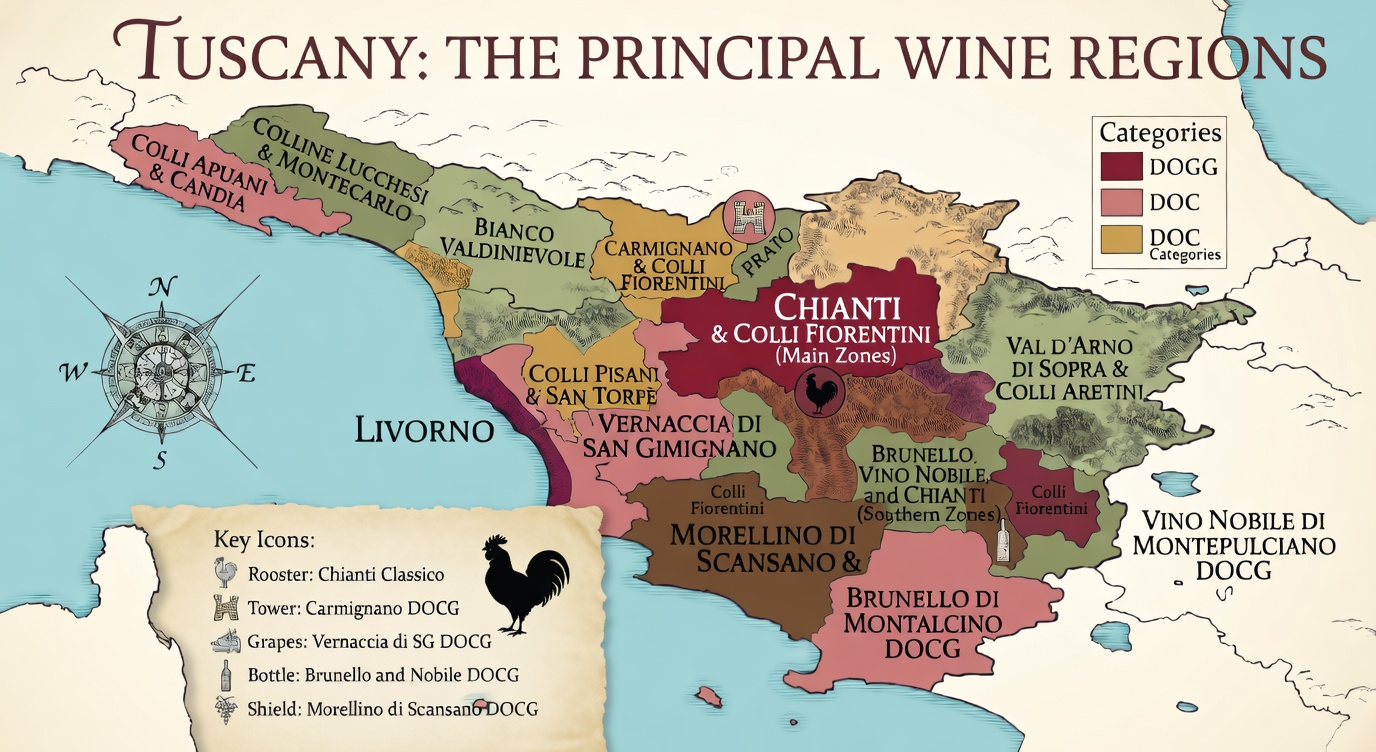
Chianti
The heartland villa region. Chianti runs roughly 60km along the SS222 Chiantigiana road between Florence and Siena, taking in the wine-country villages of Greve, Panzano, Radda in Chianti, and Gaiole. On the map it occupies the central-northern corridor between the two cities. This is where the classic Tuscany landscape, vine terraces, stone farmhouses, cypress avenues, estate wine shops, is most concentrated, and it is also where most of the regional Tuscan food specialities you'll eat on holiday come from: bistecca alla Fiorentina, ribollita, pecorino, and Chianti Classico. Villa density is the highest of any region, meaning the best selection at every price point. Browse Chianti villas →
Val d'Orcia
The showpiece. The Val d'Orcia UNESCO landscape lies southeast of Siena, roughly 90-120 minutes from Florence. The main anchor towns, Pienza, Montalcino, Montepulciano, sit on ridges above the famous rolling clay valley. This is southern Tuscany at its most cinematic. Villas here are more remote and more spread out than in Chianti; many are accessed via unpaved white gravel roads (strade bianche) that require a robust hire car and comfortable driving on single-track lanes. Browse Val d'Orcia villas →
Tuscan Coast & Maremma
The wild south. The Maremma occupies the southwest corner of the Tuscany map, a large, sparsely populated region of pine forests, wetlands, hilltop towns, and long sandy beaches. The coastline here is less crowded than Liguria or the Amalfi, and the interior harbours extraordinary Etruscan towns (Pitigliano, Sorano, Sovana) that are nearly unknown to international visitors. The only Tuscany region combining proper countryside with genuine beach access. Browse coastal and Maremma villas →
Umbria
Just across the Tuscan border, Umbria earns its place on this map because many villa holidays naturally extend into it. Assisi, Orvieto, Spoleto, and Perugia are within easy reach of southern Tuscany bases. Umbria's hilltop towns offer the same medieval atmosphere as Tuscany's, with a fraction of the visitor numbers. Browse Umbria villas →
Tuscany Tourist Map
Tuscany has more UNESCO World Heritage Sites than any comparable region in Europe. Here is how the key attractions map out, so you can plan realistic day trips from your villa base.
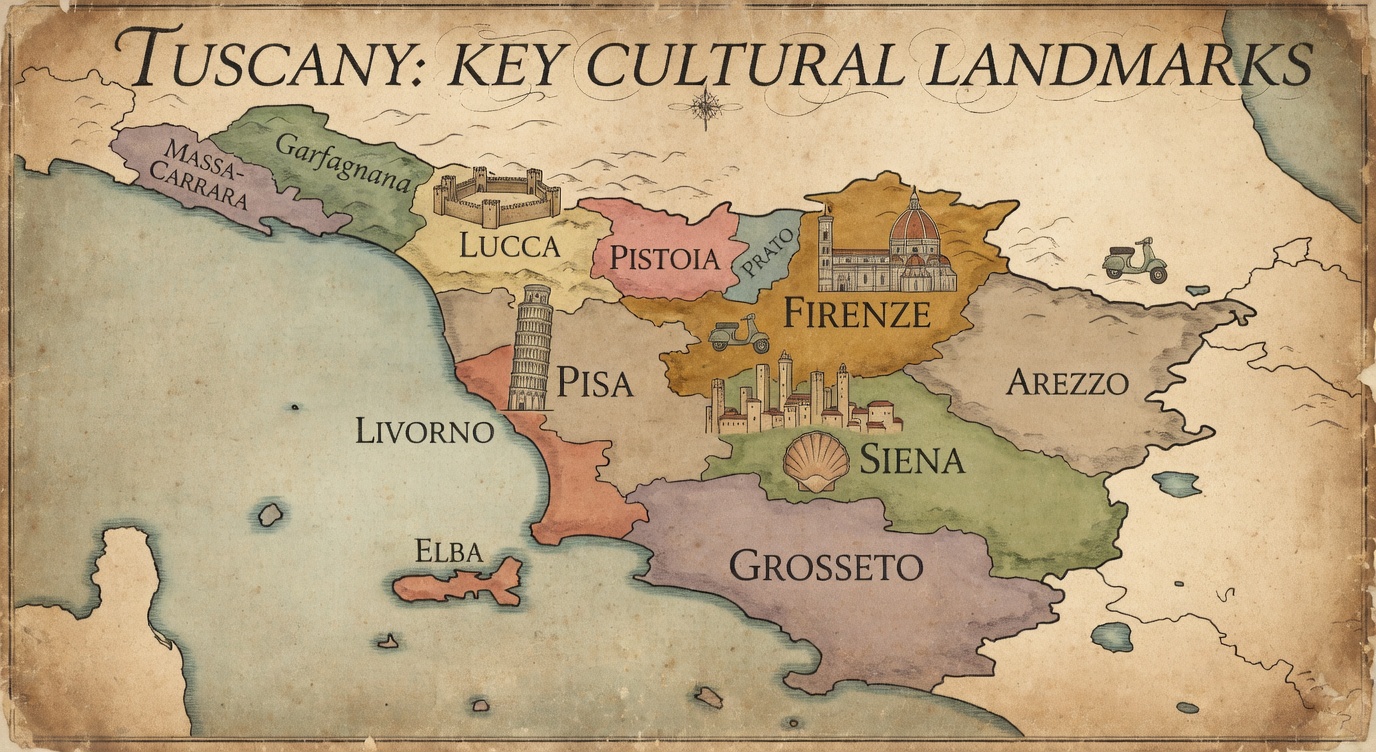
Florence, Uffizi Gallery, Duomo and Baptistery, Ponte Vecchio, Michelangelo's David at the Accademia, Piazzale Michelangelo for the panorama. A full day minimum; comfortably reached from any Chianti villa in 45 minutes, a longer 2-hour excursion from Val d'Orcia.
Siena, Piazza del Campo (site of the Palio horse race, twice a year), the Duomo's extraordinary marble façade, the Pinacoteca Nazionale. Allow half a day from a villa; Siena is 30-40 minutes from southern Chianti and 40-60 minutes from Val d'Orcia.
San Gimignano, The tower town, 55km from Florence and 45 minutes from Siena. Thirteen medieval towers still stand above a beautifully preserved hilltop centre. Best visited early morning before the coaches arrive. The local Vernaccia white wine is excellent.
Pienza, The ideal Renaissance town, rebuilt by Pope Pius II in the 15th century. Famous for its pecorino cheese, the panoramic terraces above the Val d'Orcia, and the view from the Duomo steps at sunset. A cornerstone of any Val d'Orcia itinerary.
Montalcino, A severe hilltop fortress town producing Brunello, one of Italy's greatest red wines. The best wine shopping in Tuscany; the views from the fortress walls over the Val d'Orcia are outstanding.
Lucca, Renaissance walls, tower houses, the San Frediano and San Michele churches, a lively food and restaurant scene. One of the most relaxed cities in Italy for an afternoon. Easily reached from Chianti in 90 minutes.
Volterra, A severe Etruscan and medieval hilltop city west of Siena, less visited than San Gimignano and more atmospheric. Alabaster workshops, an Etruscan museum, and a Roman theatre make it worth the detour.
Cortona, The steep hilltop town above the Valdichiana, with superb views across to Umbria's Lake Trasimeno. Good access to both southern Tuscany and Umbria's Orvieto and Assisi.
Printable Map of Tuscany with Towns
A good printed map is still one of the most reliable tools for exploring Tuscany by car, sat nav loses signal on white gravel roads between estates, and a physical map lets you see at a glance how the regions connect. Our printable map of Tuscany covers all ten provinces, the major cities (Florence, Siena, Pisa, Lucca, Arezzo, Grosseto), the four main villa regions (Chianti, Val d'Orcia, Tuscan Coast and Umbria), and the key hilltop towns most guests visit on day trips. Towns and villages are labelled clearly at 1:600,000 scale, readable in a car without magnification.
The map is formatted for A4 and US Letter paper. Print at full page, landscape orientation, with scaling set to 'fit to page' for the clearest result. For use in a car, printing at 150% on A4 then folding to A5 fits neatly in most glove compartments. The design works in colour or black and white, region boundaries are distinguished by line weight as well as colour, so nothing is lost if you only have access to a mono printer.
For offline use during your trip, save the PDF to your phone before you leave home and open it once on Wi-Fi to cache it. It then works without any mobile signal, useful when you're 15km down a strada bianca trying to work out which turning leads to the estate and which leads to an unmarked field. iOS users: save to Files → On My iPhone. Android users: the PDF will appear in your Downloads folder automatically.
The printable map works best alongside the interactive map in the section below, which lets you zoom into village-level detail and check driving distances between specific points. Use the printable version for the overall picture, which region is where, how far apart the cities are, and how the regions connect across the map. Use the interactive version to plan individual day trips in detail before you travel.
Printable Map of Tuscany (PDF)
All four holiday regions, main driving routes, cities, and key distances, formatted for A4 printing.
Open Printable Map →Interactive Map of Tuscany
Use the interactive map below to explore the region, zoom into specific villa areas, and check driving distances between your potential base and the towns on your wishlist. The map is powered by Google Maps and supports all the usual gestures, drag to pan, scroll or pinch to zoom, and double-click to zoom in on a specific point.
Interactive map of Tuscany, zoom in to explore villa areas, cities, and driving routes.
What's marked on the map: all ten Tuscan provincial capitals (Florence, Siena, Pisa, Lucca, Arezzo, Grosseto, Livorno, Pistoia, Prato, Massa-Carrara), the most-visited hilltop towns (San Gimignano, Volterra, Pienza, Montalcino, Montepulciano, Cortona, Pitigliano, Sorano), the main motorways (A1, A11) and scenic roads (SS222 Chiantigiana, SS2 Via Cassia), and the approximate extent of each holiday region. Zoom in one or two levels and individual village-level labels appear; switch to satellite view via the controls in the top-left for terrain context, it's the clearest way to see the Val d'Orcia valley shape, the Tuscan coastline, and the forested interior of the Maremma. The dedicated printable Tuscany map is also available as a separate download.
Using it on mobile vs desktop: on desktop, right-click anywhere to open a context menu for driving directions, Street View, or measuring a distance between two points. On mobile, tap a pin to see its name and tap again to open directions in your Google Maps app, a handy way to save candidate day-trip destinations while you're still planning the holiday. Pinch to zoom rather than double-tapping on phones, which sometimes registers as a selection on touch devices.
Full-screen view: tap the expand icon in the top-right corner of the embedded map for a large-format view with the full Google Maps toolbar, including layers for traffic, transit, and terrain. This is the easiest way to trace a specific day-trip route or compare distances between two potential villa bases side by side.
Tip: use this map alongside our destinations guide to see which villas sit within easy reach of your priority sights and which require more of a committed drive. If you'd like a static version you can print and fold into the glove compartment, see the printable map of Tuscany with towns section above.
Where to Stay in Tuscany by Area
Once you understand the map, the next step is matching your travel style to the right region. Here is a brief guide to who each area suits best, with direct links to browse the villa collection in each. For a fuller comparison of the best Tuscan areas for villa stays, including honest pros and cons for each region and who they suit best, see our dedicated guide.
Chianti: Best for wine lovers and first-timers
A villa in Chianti places you midway between Florence and Siena, both cities are comfortable day trips. The SS222 villages (Greve, Panzano, Radda in Chianti) offer excellent restaurants, Thursday markets, and wine estate visits within minutes of most properties. Road conditions are generally good. This is the most practical base for guests who want variety without a lot of driving. Browse our Chianti villa rentals, or read the full Chianti destination guide.
Val d'Orcia: Best for landscape seekers
The UNESCO-listed valley south of Siena delivers Tuscany's most dramatic scenery, the rolling clay hills, the cypress avenues, Pienza and Montalcino on their ridges. The tradeoff is remoteness: a day trip to Florence from here involves two hours each way. Best for guests who have come specifically for the landscape and are happy to make Siena their city excursion. Note that Rome airport is often the faster arrival at 2h30. Browse our Val d'Orcia villa rentals, or read the full Val d'Orcia destination guide.
Tuscan Coast & Maremma: Best for beach + countryside
The only Tuscany region combining serious inland countryside with proper beach access. Ideal for groups with mixed priorities, those who want cypresses and olive groves in the morning and a swim in the afternoon. September is exceptional here: warm water, cooler inland temperatures, and none of August's crowds. Browse coastal villas in our collection, or read the Tuscan Coast destination guide.
Umbria: Best for escaping the tourist trail
Just across the Tuscan border, Umbria's hilltop towns, Assisi, Orvieto, Spoleto, Gubbio, offer the same medieval atmosphere as Tuscany's classics with a fraction of the visitor numbers. Villa stays here work best for guests who've already covered the Tuscany highlights and want something quieter, more unspoiled, and genuinely off the main tourist circuits. Comparable Umbrian properties typically run 20–30% below Chianti prices. Browse Umbrian villa rentals, or read the Umbria destination guide.
Not Sure Which Region Yet?
If you're still deciding between regions, our full collection is the best starting point. Browse all Tuscany villa rentals, or narrow by what matters most: villas with a private pool, large-group villas, family villas, or luxury villas.
Not sure which area is right for you? Read our full guide to the best areas to rent a villa in Tuscany, or get in touch with our team, we know every road and every region.
Tuscany Average Temperatures by Month
Planning your travel dates? Here is a quick reference for average temperatures across central Tuscany (Chianti and Val d'Orcia). The Maremma coast runs 1-2°C warmer in summer; the higher Chianti hills (Radda, Gaiole) run 2-3°C cooler than the valley floors shown below. For a full month-by-month weather guide including rainfall, pool-usable dates, and regional microclimates, see our Tuscany weather guide.
| Month | Avg Temp | High | Low | Rainfall | Pool Use |
|---|---|---|---|---|---|
| Jan | 8°C | 11°C | 4°C | High | , |
| Feb | 9°C | 13°C | 4°C | High | , |
| Mar | 12°C | 16°C | 7°C | Moderate | , |
| Apr | 15°C | 19°C | 10°C | Moderate | , |
| May | 20°C | 24°C | 14°C | Low | Warm days |
| Jun | 24°C | 29°C | 17°C | Very low | ✓ |
| Jul | 27°C | 33°C | 20°C | Minimal | ✓✓ |
| Aug | 27°C | 33°C | 19°C | Minimal | ✓✓ |
| Sep | 23°C | 28°C | 16°C | Low | ✓✓ |
| Oct | 17°C | 21°C | 12°C | Moderate | Warm days |
| Nov | 12°C | 15°C | 8°C | High | , |
| Dec | 8°C | 11°C | 4°C | High | , |
Central Tuscany (Chianti / Val d'Orcia). Maremma coast runs 1-2°C warmer in summer; upper Chianti hills 2-3°C cooler.
The clearest pattern for villa holidays: May and June offer warm, comfortable weather with green landscapes and wildflowers, the pool is usable from late May. July and August are peak season: very hot (32-38°C), busy in the towns, and the pool becomes essential rather than optional. September and October are the locals' favourite months, harvest season, golden light, cooler evenings, and the fewest crowds of any warm period. Pool season extends comfortably through September.
Frequently Asked Questions About Tuscany Maps
Where is Tuscany located in Italy?
Tuscany is a region in central Italy on the western (Tyrrhenian) side of the peninsula, between Liguria and Emilia-Romagna to the north, Umbria and the Marche to the east, and Lazio (home to Rome) to the south. Florence, the regional capital, sits roughly 300km north of Rome and is served by direct high-speed trains from both Rome and Milan. See the "Where is Tuscany on the Map of Italy?" section above for a fuller orientation with distances and airports.
How big is Tuscany?
Tuscany covers approximately 22,993 km² and stretches roughly 230km from north to south, larger than Wales. It contains ten provinces and over 3.7 million inhabitants. Most villa holiday destinations are concentrated in the central band between Florence and the Val d'Orcia, a zone roughly 100km long. The drive from the northern Chianti to the southern Maremma takes around two and a half hours end to end.
How many provinces does Tuscany have?
Tuscany has ten official provinces: Firenze (Florence), Siena, Arezzo, Grosseto, Lucca, Pisa, Livorno, Pistoia, Prato, and Massa-Carrara. For villa holidays, the four that matter most are Firenze and Siena (covering Chianti and the northern Val d'Orcia), Grosseto (the Maremma and Tuscan Coast), and Lucca (the walled city and northwest).
What is the capital of Tuscany?
Florence (Firenze in Italian) is the capital of Tuscany, historically the cradle of the Italian Renaissance and today the region's largest city, administrative centre, and main international gateway. From most Chianti villa bases, Florence is a 45-minute drive and the primary day-trip destination for visitors staying in the northern half of the region.
Is Florence in Tuscany?
Yes, Florence is the regional capital of Tuscany and sits in the north-central part of the region. The surrounding province of Firenze contains many of the classic Chianti villa areas, with most properties within 45 minutes of the city centre and the Duomo.
What are the main regions of Tuscany?
For villa holidays, the four main regions are Chianti (between Florence and Siena, wine country), Val d'Orcia (southeast of Siena, UNESCO landscape), the Tuscan Coast & Maremma (southwest, beach and countryside), and Umbria (just across the Tuscan border, hilltop towns). Each has a distinct character, see the regions map section above for a full breakdown of what each one offers.
What's the difference between Tuscany and Umbria?
Tuscany and Umbria are neighbouring central Italian regions with similar landscapes, hilltop towns, vineyards, cypress-lined roads. The key differences: Tuscany is larger, more famous, and has a dedicated wine identity (Chianti, Brunello, Vino Nobile) plus a long Tyrrhenian coastline. Umbria is entirely landlocked, quieter, and typically less expensive, making it an attractive extension to a Tuscan trip rather than a competing choice.
What is the closest airport to Tuscany?
Tuscany is served by two international airports: Pisa Galileo Galilei on the west coast, the main low-cost hub with flights from across the UK and northern Europe and Florence Peretola for shorter-haul European connections. Rome Fiumicino and Bologna are also viable entry points, particularly for southern Tuscany and the Val d'Orcia, which are within 2-3 hours' drive of either.
What is the best base for exploring Tuscany?
Chianti is the most practical base for first-timers, central, well-connected, and within 45 minutes of Florence and 30-40 minutes of Siena. For the iconic Val d'Orcia scenery, a villa near Pienza or Montalcino is worth the extra remoteness. For beach access alongside Tuscan countryside, the Maremma coast is the only region that delivers both. Browse our villa collection organised by area to find the right base.
How long should I spend in Tuscany?
A week is the practical minimum for a Tuscany villa holiday, enough for two or three day trips to major cities (Florence, Siena, Lucca), a couple of wine-country afternoons, and a few days relaxing at the villa pool. Ten to fourteen days allows comfortable day trips deeper into Val d'Orcia, the Tuscan Coast, and neighbouring Umbria without feeling rushed.
Is Tuscany easy to drive around?
Yes, Tuscany is well-suited to self-drive touring. The A1 motorway connects Florence to Siena and Chiusi; the A11 runs west from Florence to Pisa and Livorno. The scenic SS222 Chiantigiana road through Chianti and the Via Cassia (SS2) through the Val d'Orcia are straightforward on a standard map app. The main practical note: historic town centres in Siena, Pisa, Lucca, and most hill towns operate ZTL zones (Zona a Traffico Limitato), park outside the walls and walk in to avoid fines.