Driving in Tuscany: An Honest Guide to Car Rental & Roads
Driving in Tuscany is the part of the trip most international visitors worry about, and it shouldn't be. The basics aren't complicated, the country is well-signed in English on all major roads, and the rural lanes that look intimidating in photographs are usually fine once you're behind the wheel. But there are real, specific differences from the UK and especially from North America that catch people out: car size constraints that turn a perfectly reasonable American rental into a daily struggle, ZTL no-car zones that generate fines arriving months after you've gone home, and the strade bianche white-gravel roads that most Tuscan villas sit at the end of. This guide covers what you actually need to know.
Driving in Tuscany at a glance: A car is essential for almost any villa holiday — rural villas, dispersed villages, limited public transport. Rent the smallest practical car for your group; full-size US SUVs are too wide for Tuscan rural roads. Italian rentals are mostly manual transmission — book automatic 4-8 weeks ahead if you need one. Never drive into a historic city centre (ZTL fines arrive months later via your rental company). Most Tuscan villas sit at the end of a strada bianca (white-gravel road), entirely fine in a normal car driven slowly. The right-of-way conventions at unmarked intersections and roundabouts differ from North America and merit a quick read before you set off. See our Tuscany airports guide for where to pick up your rental.
Why You Need a Car for a Tuscany Villa Holiday
Tuscan villas are rural by definition. The properties sit in countryside several kilometres from the nearest village; the wine estates, restaurants and hill towns you'll want to visit are dispersed across rolling country with limited or no public transport between them. Even guests who plan a quiet villa-and-pool week typically want a car for two or three restaurant evenings, a wine estate visit, and at least one day trip to Florence, Siena, San Gimignano or a similar nearby town.
The only practical alternatives are a private transfer in and out (workable for a true villa-only week with chef-on-site service) or staying in a hotel in central Florence and exploring by train (a different kind of holiday altogether). For the standard Tuscan villa rhythm — countryside base, occasional outings, wine and restaurant evenings — a rental car is essentially required. For where to rent and the airport-by-airport breakdown, see our Tuscany airports guide.
Where to Rent: Airports, Cities and Online Brokers
The major Tuscany-relevant airports — Pisa (PSA), Florence (FLR), Rome Fiumicino (FCO), Bologna (BLQ) and Perugia (PEG) — all have on-site rental car offices from Hertz, Europcar, Avis, Sixt and Goldcar. Pisa and Rome consistently offer the widest selection and the keenest prices. Florence Peretola has a smaller rental car building with fewer automatic options.
Booking online ahead of time via aggregators (Auto Europe, RentalCars, Skyscanner Car Hire, Discover Cars) typically beats the in-airport rate by 30-60%. Same-day rental in August is dramatically more expensive and may not be available at all in the smaller categories. Book at least 2-3 weeks ahead; for automatic transmission, book 4-8 weeks ahead.
Rental from a city office (Florence Santa Maria Novella, Siena station) is sometimes useful if you only want the car for the rural portion of the trip and are arriving by train. The trade-off: city offices charge a 'one-way' or central-location surcharge typically €40-€80 on top of the airport rate.
What Size Car to Rent (The Single Most Important Decision)
This is where most international visitors, and especially North Americans, get it wrong. Italian rural roads are designed for cars 1.7 to 1.8 metres wide. The standard Italian compact (Fiat Panda 1.66m, VW Polo 1.75m, Renault Clio 1.73m) is the format the road system, parking spaces, village access and gravel-road driveways are built around. A full-size US SUV (Chevrolet Tahoe 2.04m, Ford Expedition 2.03m, Cadillac Escalade 2.06m) is 30 to 40 centimetres wider — enough to make routine driving genuinely uncomfortable and the narrowest village lanes occasionally impossible.
The right Tuscan rental category for most parties:
| Group size | Recommended category | Examples |
|---|---|---|
| 1-2 adults | Economy or Compact | Fiat Panda, Toyota Aygo, VW Polo |
| 3-4 adults | Compact or Mid-size | Fiat Tipo, Renault Clio, VW Golf, Skoda Octavia |
| 4-5 adults with luggage | Mid-size estate / wagon | Skoda Octavia Estate, VW Passat Variant |
| 5-7 adults | Compact 7-seater MPV | VW Touran, Renault Grand Scenic, Citroen Grand C4 |
| 8+ adults | Two separate cars | (not a single large van) |
Resist the temptation to size up 'for comfort'. A compact car in Italy delivers more comfort than a full-size SUV because parking, narrow road negotiation, gravel-road driveways and village access are all genuinely easier. The mid-size car you'd rent in the US is the largest size that works well in Tuscany.
ZTL: The No-Car Zones in Historic Centres
ZTL (Zona a Traffico Limitato, 'restricted traffic zone') is the name for Italy's no-car zones in historic city centres. Almost every historic Tuscan town has one — Florence, Siena, Lucca, Pisa, San Gimignano, Pitigliano, Cortona, Pienza, Montepulciano, Volterra. The ZTL covers the walled or historic core and is monitored by cameras at every entry point. Non-resident vehicles entering during restricted hours are fined automatically.
How the fines work: The camera records your number plate. The fine (typically €80-€150 per entry) is sent first to the rental car company, who pay it on your behalf and then bill your credit card 6-12 months later, adding an administrative surcharge of €40-€80 on top. A single ZTL entry can easily cost €150-€250 in total. Multiple entries on the same day count as multiple fines.
The simple rule: never drive into a Tuscan historic centre. The walls and signposted ZTL boundaries are clearly marked with 'ZTL', 'varco attivo' (active gate) or 'zona traffico limitato' signs, sometimes accompanied by a clock symbol showing the active hours. Park in one of the signed car parks outside the walls — every Tuscan walled town has them, well-signed in English with the letter 'P' on a blue background — and walk in. The walk from a peripheral car park into a Tuscan historic centre is rarely more than 10 minutes.
Exceptions and edge cases: Hotels and B&Bs inside a ZTL can register your plate for permitted entry during the booking, allowing you to drive in to drop off luggage. Villas are essentially never inside a ZTL. If you're staying overnight in central Florence, Siena or Lucca, work the ZTL question into your booking with the property. Do not assume your sat-nav knows where ZTLs are — many cheaper systems route directly through restricted zones without warning.
Strade Bianche: The White-Gravel Roads
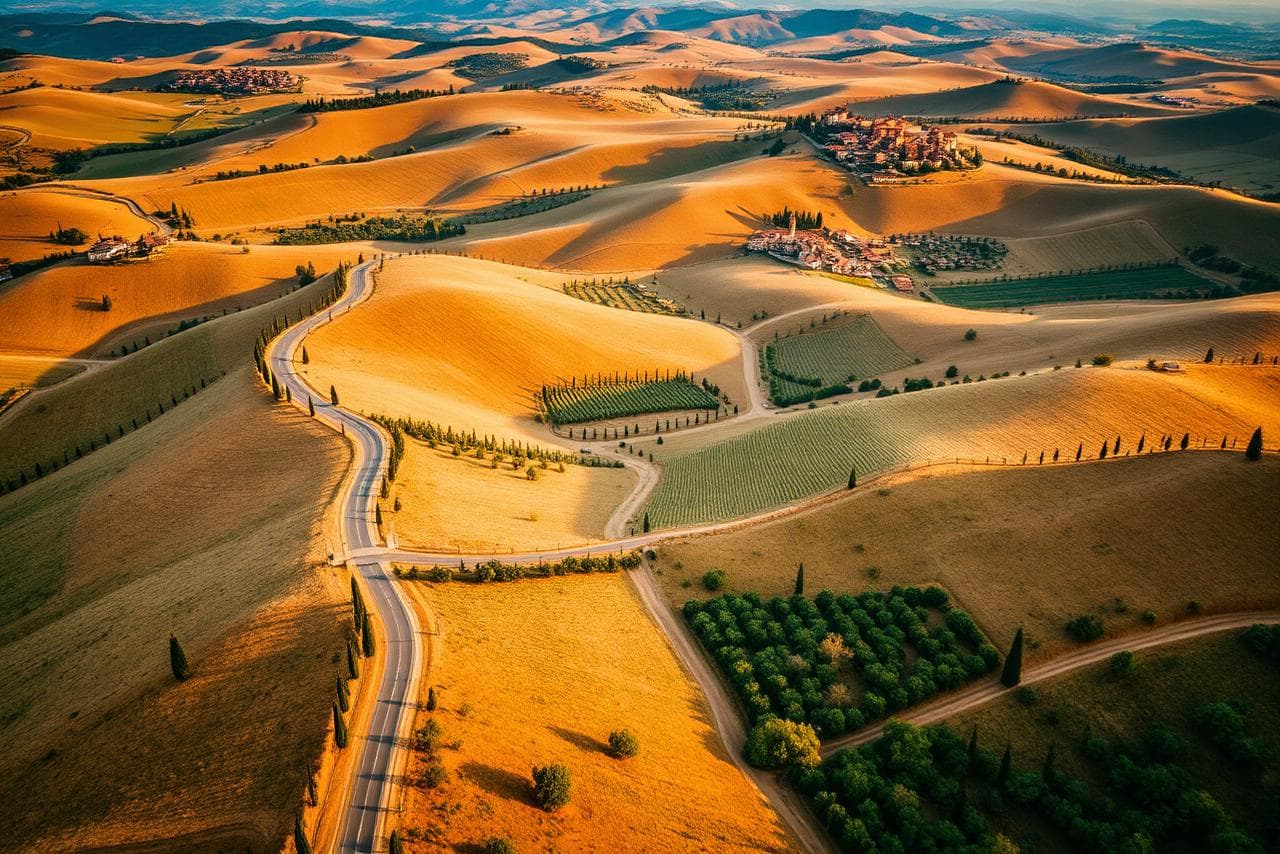
Strade bianche are 'white roads' — unpaved compacted gravel roads, named for the pale colour of the local stone they're made from. Most Tuscan villas sit at the end of one, typically 100 metres to several kilometres in length. The white-gravel landscape of the Val d'Orcia is dotted with them; Chianti villas frequently use them for the final stretch from the paved SR222 down to individual estates.
Driving on them is entirely manageable in a normal hire car. The practical guidance:
- Speed: 20-40 km/h is appropriate; faster throws up dust and damages the surface for everyone.
- Clearance: low-slung sports cars and some sedans (especially after heavy rain when ruts form) can scrape; a compact estate or small SUV is fine.
- Weather: after heavy rain, gravel roads become muddy and occasionally rutted. Drive slower; allow more braking distance.
- Dust: any car driven on strade bianche will be coated in fine pale dust by the end of the trip. Returning a clean car at the airport may need a car wash en route (the autostrada services have automated ones).
- Right of way: where two cars meet on a narrow strada bianca, the convention is that the car going downhill reverses to the nearest passing place. Wave thanks; Italian rural courtesy is real.
There is no reason to be intimidated by strade bianche. They are completely standard for Tuscan rural driving and Italian drivers treat them as ordinary infrastructure. Even small hire cars handle them comfortably at sensible speeds.
Narrow Rural Roads and Villa Access
Beyond the strade bianche, Tuscan rural roads themselves are often narrower than visitors anticipate. Many paved country lanes between Chianti villages or in the Val d'Orcia are single-track with passing places (piazzole di sosta) every 100-300 metres. The rules are the same as on British country lanes: where two cars meet, one pulls into the nearest passing place; the descending car typically gives way.
The most awkward stretches are usually the final kilometre of villa access — narrow lanes between dry-stone walls, switchbacks down steep slopes, occasional gates or cattle grids, and parking areas that require a three-point turn. None of this is dangerous; all of it is harder in a wider car. This is the single biggest reason to rent at the smaller end of the size category that fits your group.
Practical tips for narrow rural driving:
- Slow down approaching blind corners. Locals know the roads; you don't.
- Use horn briefly approaching blind bends on single-track roads — Italian convention treats this as a friendly warning, not aggression.
- Don't trust GPS routing literally for the last kilometre. Many sat-navs route via the shortest stradina (small road) rather than the easiest one. Ask the villa for written or photographed directions to use as backup.
- For very narrow stretches, fold in your wing mirrors. Most rental cars have manual fold (push on the mirror housing from outside, or button on the door from inside).
- Reverse into tight parking spots when you arrive (so you can drive forward out). Italian habit; saves stress later.
Notes for North American Visitors
Most of the concerns above apply to all international visitors, but a handful are specifically pronounced for guests arriving from the US or Canada. Worth covering in their own section.
Car width is the big one. The average new US car is around 1.85m wide; the typical US SUV is 1.95-2.05m; full-size pickup trucks and large SUVs (Tahoe, Suburban, Expedition, Escalade, F-150) push 2.0-2.1m. Italian rural roads, village access lanes and parking spaces are designed around cars 1.7-1.8m wide. The 20-30 cm difference doesn't sound like much, but when you're inching down a 2.4m-wide stone-walled lane with passing places every 200m, the difference between a Fiat Tipo and a Tahoe is the difference between routine and exhausting. Rent a category smaller than you'd consider in the US, and never default to a 'full-size SUV' as a rental category in Italy. Compact estate or compact 7-seater MPV is almost always the right call.
Manual transmission is the Italian norm. US drivers are overwhelmingly automatic-only by experience. Italian rentals are mostly manual, automatic options are limited in fleet, and automatic fares run 30-100% higher than manual. Book at least 4-8 weeks ahead for automatic, expect to pay more, and don't accept the smallest economy category since automatic fleet availability is thinnest there. All major brands (Hertz, Europcar, Avis, Sixt) have automatic Compact and Mid-size SUVs at the main Tuscan airports; the budget brands (Goldcar, Locauto, Centauro) have fewer automatics and run out earliest in peak summer.
Right-of-way conventions differ from the US. At unmarked intersections in Italy, the vehicle FROM THE RIGHT has priority — quite different from the US 'first come, first through' or stop-sign-controlled conventions. At roundabouts (rotatorie), traffic ALREADY IN the circle has priority; entering traffic must yield. Many US states do it the same way now, but Italian drivers enter roundabouts more assertively than typical US drivers and often don't signal their exit. Don't stop in a roundabout once you've entered.
Speed cameras (autovelox) are abundant and unannounced. Italy uses fixed cameras extensively, and rental cars are not exempt — fines arrive 6-12 months later via the rental company with an administrative surcharge. Limits are 50 km/h in built-up areas, 90 km/h on rural roads, 110 km/h on dual carriageways (raccordi), and 130 km/h on the autostrada. Sticking to the posted limit is the only reliable defence.
Diesel rentals are normal. Most Italian rental cars are diesel (gasolio). At fuel stations you'll see gasolio (diesel) and benzina (petrol/gasoline). Confirm at pickup which your car takes; misfuelling is expensive. Self-service pumps are standard at modern stations; older ones still have servito (attendant-served, ~€0.10/litre more).
An International Driving Permit (IDP) is technically required for US, Canadian and Australian drivers per Italian law. It's rarely checked at rental pickup or by police, but if you have an accident without one your rental insurance can be voided. In the US, the IDP is issued same-day by AAA for about $20 — worth getting for the small risk it covers. UK driving licences are accepted without an IDP.
Italian Driving Culture
Italian driving is more assertive than UK or US driving, but rarely aggressive in the genuine sense. The patterns to expect:
- Closer following distances: Italian drivers maintain noticeably smaller gaps than UK or US convention. It's not personal; it's normal. Don't speed up to escape; don't brake to send a message.
- More frequent overtaking: on rural roads and the autostrada, expect to be overtaken more often, including on slight uphill stretches or on the inside of slow vehicles. Stick to your lane.
- Light and assertive horn use: a short toot is conversational ('I'm here', 'I'm coming round the bend', 'thanks'), not angry. Long horn presses are genuine displeasure but rare.
- Strict autostrada lane discipline: the leftmost lane is genuinely for overtaking only. Stay in the right lane unless actively passing.
- Pedestrians at marked crossings: technically have priority, but always cross with caution; Italian drivers don't always stop reliably.
Fuel, Tolls and Parking
Fuel: benzina (petrol), gasolio (diesel). Confirm at pickup. Self-service is standard at modern stations. Autostrada services every 30-50 km, typically open 24 hours; town and village stations may close midday and overnight, so don't run low in the evening in rural areas.
Autostrada tolls: take a ticket on entry, pay on exit (card or cash). Avoid yellow Telepass lanes — those are electronic-only and trigger an unpaid-toll fine if you use them without a transponder. Typical costs: Florence-Rome around €22, Pisa-Florence around €8.
Parking: white-lined spaces are free, blue-lined are paid (buy from the parcometro machine, display the ticket on the dashboard), yellow-lined are residents-only. Most Tuscan towns have signed car parks ('P' on blue background) outside the historic walls.
Insurance and Excess
Standard EU rental insurance includes CDW (Collision Damage Waiver) and Theft Protection, but with a high excess — typically €1,000-€2,500. If you damage the car, you're liable up to the excess.
Two ways to handle the excess: buy the rental company's 'Super CDW' (reduces excess to zero, but costs €15-€30 per day, often more than the base rental); or take out a standalone excess insurance policy with a third party (RentalCover, iCarHireInsurance, Allianz) before the trip, typically €5-€10 per day with broader cover than the rental company sells. Some premium credit cards (Amex Platinum, certain Chase cards in the US) include rental car insurance — check the terms before relying on it.
Most experienced Tuscan visitors take out third-party excess insurance: better coverage, lower cost, no surprise excess deductions if anything goes wrong.
Returning the Car
Refuel before return — the rental companies' 'full-to-empty' fuel option costs 2-3× the pump rate. There are fuel stations near every major Tuscan airport; allow 15 minutes for the detour. Inspect the car before handing back; take photos of all four corners and the interior, with a timestamp. Get a written return receipt confirming no damage. Keep the rental contract for at least 12 months — ZTL fines arrive 6-12 months later and you'll need the dates to contest mistakes.
Final Thoughts
None of the above should put you off driving in Tuscany. The basics are straightforward: rent smaller than you would in the US, never drive into a historic centre, take the strade bianche slowly, and resist the urge to follow your sat-nav literally for the last kilometre to the villa. Italian roads in 2026 are well-maintained, well-signed, and used daily by visitors who never had a problem they couldn't manage. For more on where to base yourself, see our regions of Tuscany guide and our best areas to rent a villa in Tuscany. For arrival logistics by airport, see our Tuscany airports guide.
Note: This guide is intended to help you prepare for driving in Tuscany based on what we and our guests have learned over many trips. It is not legal advice. Italian driving laws, ZTL boundaries and hours, fine amounts, insurance terms and International Driving Permit rules change periodically and vary by municipality. Always verify the specifics relevant to your trip with your rental company, your insurer, your embassy and the relevant Italian authorities before relying on any single point here. We update the guide periodically but cannot guarantee real-time accuracy of every figure.